
Memoirs of a Village Bride
 Written by
Tana
When you step out of your mudbrick hut, you see that half of your guests are dressed in the same fabric as your bridesmaids. People that you don't even know show up, and kids from all over the area are there for the free meal. They spend the whole time blowing on noisemakers and climbing on the walls. Let's not forget that all three town drunks have shown up for the locally brewed beer. Your hired entertainment (the town crier) is harassing your guests for money with his megaphone.
Then it's time to dance the day and night and next morning away.

The hot dance of the moment is a slow shuffling in a circle while shaking your booty. When you do this dance, make sure your booty oscillates four times the rate of your feet. All the single ladies over forty try to catch the eyes of musicians as they inch past them.

After all that dancing, you're hungry.

Sometimes, your wedding band will strike up an African instrumental remix of "If You're Happy and You Know It, Clap Your Hands."


The Great Wall of Chana
Written by
Chad

A couple months ago, Tana awoke with a mystical vision haunting her slumber. In her dream, the clouds parted and the angels trumpeted as an unearthly voice bellowed: “If you build it, they won’t come.” We deciphered this cryptic prophecy to mean: if we were to construct a walled-in courtyard, we would be ridded of those free-roaming courtyard goats. And free from the daily toil of sweeping their droppings off our porch. Not only that, a courtyard would allow us to stargaze in our pajamas, plant a vegetable garden, and host the closest approximation to an all-American Super Bowl cookout. I just knew there was a reason I packed that “kiss the cook” apron. Anyway, we don’t get good ideas very often, so we ran with it. We figured having a wall between us and the elements would be a good investment in our future sanity.


Thus began a project so chockfull of production delays and miscommunications that it could have just as well come out of a modern-day bureaucracy, the IRS for instance. If a book existed on how not to get something accomplished, our courtyard fiasco would qualify as the feature chapter. For example, take the bricks themselves. First, the brick-maker dude ran out of water to convert clay into blocks. Then, in transit the bricks crumbled apart like cake. Then those demonic goats somehow scaled our five-foot brick pile and performed the Riverdance each night until daybreak. This was mere feet from our bedroom window. It’s some sort of in-built personality disorder of all goats to want to climb on everything—apparently you can take the goat out of the mountain, but you can’t take mountain out of the goat. After that ordeal, it rained and the clay dissolved into a sludge-like consistency. By the time the wall was fully realized a month and a half later, one hundred bricks had fallen by the wayside. What began as a simple commission had become a runaway train, though thankfully the end result wasn’t a train wreck. The finished wall and door looks amazing- see?

Despite the project’s general run-amokery, there were plenty of golden moments. To transport sand for cement, I accompanied Siaka on a wagon towed by his two prized bulls. Being the anglophile that he is, Siaka calls each of his pets Big Boy, which sounds kind of like “Beeg Bwy” in his French accent. Whenever a bull would become flustered, he would soothe it by yelling “Beeeeeg!” Talking the bulls down turned out to be important. From the moment I hopped on the wagon, both Big Boys decided to go full-speed ahead into the brush. They plowed over a helpless papaya tree and might have trampled a hut full of beer-drinking villagers had Siaka not chased down the wagon and halted them. After this little skirmish, our bull-drawn carriage floated elegantly through the village commons where I waved like Prince William at my neighbors. We stopped near Salif’s house and shoveled sand into the wagon, then back home. I got our adventures on video, but the camerawork is so Blair Witch Project-y that I hope it doesn’t activate anyone’s epilepsy.
The Real World: Ouagadougou
Written by
Chad


Incomprehensibly Yours
Written by
Chad

I'm not always understood even in my mothertongue. Often when I approach some people chatting enthusiastically, I have this tendency to cannonball right in mid-conversation with some offhand comment. That's when the music abruptly cuts off with a needle scratch and everyone around the room's smiles fall flat, as if vacuumed into the black hole of my irretractable words. Then after the awkward stares of bewilderment, the people I interrupted explain, "We were talking about such-and-such, not about whether American Idol should do a spin-off for pets." This also happens in lots of other situations besides the incident above when I accidentally attended a Lamaze class.
Anyway, as if I wasn't already socially inelegant enough, our plane lands here, smack dab in the middle of Nobody-Understands-English-Land. Now I wear my social ineptitude like a scarlet letter on my chronically unshaven visage. On any given day in America there's a likely chance my mouth's sputterings won't make sense, but here it's a foregone conclusion. If conversation is some kind of exquisite ballroom dance, then in the States maybe I'm a wallflower with two left feet and in Africa I'm some kind of blind, paraplegic amputee... who's comatose. If you happen to be a blind, comatose amputee who happens to be reading this, please don't take offense until after the next paragraph (after which you'll pity me and drop the lawsuit). Also, wow, talk about a coincidence.
Anyway, having spent the first twenty-four years of my life greeting people with a simple hello, my brain isn't conditioned to greet people according to the time of day. I'm walking along daydreaming whimsically, then someone jumps out of nowhere and I panic: is it morning, afternoon, evening, or night? Since I think in the Queen's English, I have to translate my ballpark guess in a split second. My default impulse is usually blurting out "Ani wula" (good evening). Especially in the morning to the first person I encounter. Excuse me if I don't keep tabs on the sun's position every waking moment. The sun and I have an agreement. I stay out of his business, don't stare directly at him, and he doesn't burn my face off.
So today, as a friend--or complete stranger, depending--I'd like to impart to you some of the quirky nuances of communicating in West Africa. That way if you quit your successful job and move to West Africa, you won't be doomed on countless occasions to blunder as I have. First thing, you'll need to know the rudimentary nonverbals:
- You know how an American preschooler likes to wave--holding his hand up like he's taking an oath and flapping his four fingers up and down? That's how you beckon somebody here in Africa. Or you can yell Fozzy Bear's signature catch phrase, which in the local language of the Mossi people translates to "come hither."
- To beckon a dog in West Africa, make a clicking noise with the front of your mouth. To beckon chickens or chicks, make a side-mouth click. Yes, there's a difference- try it, you naysayer. To beckon computer mice, I'm not sure.
- To shoo away pesky animals, you hiss at them. It works, too. And although I haven't lab-tested it, I have a theory that snakes might interpret this as flirtation.
- Speaking of which, if you ever scratch someone's palm with your pointer finger while handshaking, this is the Burkinabe equivalent of brazenly making a pass at them or delivering a smarmy, innuendo-laden pickup line. One time we hired a tiny, old man to help clean our latrine, which by the way contained a bike tire tube and a dead chicken among other buried treasures. And when I shook his hand, I felt a palm scratch and thought he was hitting on me. Sadly, it turns out his index finger was just dislocated.
- To indicate that somebody is crazy: do an upside-down gun-to-the-head gesture with your hand, then in a single rapid motion rotate your hand away from your head. This one's tricky to describe, so I hope when you perform it, people understand. If they don't, please don't sue me- an amputee group is already waging class action against me.
- To indicate someone is a man, stroke your chin like a contemplating diabolical supervillain. To indicate someone is a woman, clench two tiny imaginary damsels in your fists and hold them to your chest like King Kong.
- To get somebody's attention, make a loud cartoony smoochy noise until they look at you. We hear these smooches all the time walking through the city. As an American, it initially struck me as something the drunk at the end of the bar might do, but in reality it's as neutral as a simple "hey."
- To hail a cab, put your hand parallel to the road and fan the ground like you're patting dirt.
- After hearing bad news, it is customary to put your hand on your face. Make sure it's your own face.
- Greeting everybody you see as if they're all your best friend might be interpreted as fake in America, but here it's the best way to gain acceptance. When you're greeting someone, you can show extra respect by holding your elbow with your free hand as you handshake. Oftentimes, people will hold your hand for the entire time you talk to them--don't panic--this is normal. If you're a woman, also flex your knees in curtsy-esque maneuver. If you don't feel like shaking people's hands across the room, nod your head as you shake your own hand across your chest. You can also show respect by touching your solar plexis right after the handshake.
- To inquire "where are you going," hold one arm out with your palm facing down and then rotate it facing up. Taxi guys, eager for passengers, always do this gesture to pedestrians.
- To alert someone to danger, snap your fingers.
- To warn your enemies that you're going to hit them, raise and lower your hand in the air while snapping.

If you decide quit your job and move to West Africa, nonverbals aren't the only thing you need to know, unless you plan to be a mime. Thus, we now turn to the Jula (Dioulla) language of Burkina Faso, Mali, Senegal, Guinea, Mauritania, and Cote d'Ivoire. And forgive me- I'd rather write about the oddball stuff than be a dullard who reports useful, pertinent, meaningful matters of consequence. So here's a crash course on all the linguistic trifles I could glean from a single week of Jula class:
- The word for bicycle negeso means "metal horse."
- Some of the Jula words for body parts make me laugh. Kunsigi, the Jula word for hair, is actually a combination of the words for "head" and "sit." Bolokunadenw, the word for fingers, means "children at the head of the hand." The word for knee kunbiri means "head that bends." The word for buttocks jukuna means "head of your back." Nyadenw, the word for eyes, means "face children." In summary, your body is covered in heads and children.
- The word for diarrhea is konoboli meaning "running stomach."
- The words for basic colors are really long: neremuguman is yellow and green is binkeneman, which means "healthy grass." They only acknowledge six colors and they don't have a word for purple or orange. This must make interior decorating a chore.
- The word for a tailor, fanikalanla, means "clothes covering person." Perhaps, the most satisfying word to say is butikitigi, which is a store clerk.
- When you see somebody drinking you can say "Ala k'aw wili ni heere ye," which means "May God help you stand up with health." When you see somebody eating you can say "Ala ka suma I kono," which means "May God cool the food in your tummy." At a wedding, you can say to the bride and groom, "Ala ka bolo ni seen boara," which translates as "May God get from your marriage many hands and feet." The hands and feet of the many kids you will hypothetically have.
- In the Jula language and tradition, all sisters of your wife are also your wives (Sorry, Sherry and Stacy). I'm also obliged to share Tana with my brother Ryan as she is also his wife.
Tengrela and Then Some
Written by
Chad


Here the hippos are either sacredly kissing or sacredly brawling:

We were told, that despite the fact that hippos kill more humans than any other animal a year (apparently?), the hippos at Tengela have never attacked humans. How come, you may ask? Well, simply put, the hippos have an agreement with the Burkinabe villagers nearby that neither one will kill the others. Yes, I thought it seemed a bit far-fetched too, but when I was in a roughly-hewn canoe with six other people, rowing towards the hippos fighting in the water, I believed it, if only to diminish my fear! However, when a very old chief of the village dies, apparently it is acceptable to kill a hippo for the grand funeral. When I asked why the hippos don't get mad that the Burkinabe kill them when a chief dies, the response I got was that the hippos "just know" that the chief died.

An American missionary family invited the gang and me over for a Mexican dinner in their beautiful home. Here is Anne reading bedtime stories to the little guys and gal.


West African Whippersnappers
Written by
Chad
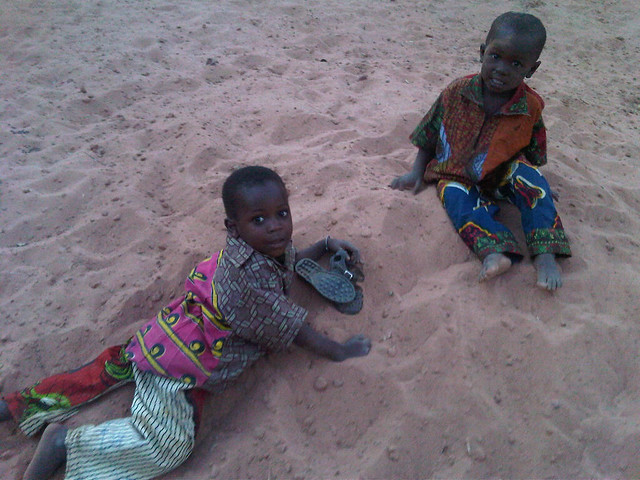


As a post post script, Tana told me my Jula spelling of sukaromusa was totally wrong, so I fixed it.
Roll Up for the Magical Factory Tour!
Written by
Chad

With over four thousand employees, SOSUCO is to Banfora what Hershey Chocolate is to Hershey, PA. So imagine our giddiness when last week we got golden tickets granting us entry inside the industrial megaplex. This birthplace of all sticky buns and lemon drops; this wonderland of tooth decay and type two diabetes. Today, you too can behold the secret world of imagination that is SOSUCO. Think of Tana as a clownishly dressed Willy Wonka and me as a sun-burnt Oompa Loompa, guiding you through the ten-step process of sugar production. Grab your insulin, cause here we go.


(3) Then it goes to the coolest part ever. While it's being spritzed with water, the paste spins around a centrifuge. You can open it up and watch the sugar crystallize, visibly changing color like a splash of cream in your coffee. At that moment a fleeting sense of appreciation for the miracles of science welled up in my chest, kind of like seeing one of those volcano science fair projects. It may have just been acid reflux.


