
Sunday, April 17, 2011
The Real World: Ouagadougou
 Written by
Chad
Written by
Chad
Thirty strangers. Three nights. One house.
I spent seven hours counting baobab trees out the bus window as we voyaged from our tropical bungalow to Burkina Faso’s capital city Wah-guh-doo-goo. We hopped off the charter bus in the big city with our luggage full of dirty-laundry-to-be and our hearts full of dreams. For dinner we taxied to the gentrified corner of town called Ouaga 2000 (a name that maybe sounds like an infomercial gadget). Indulging in coffee milkshakes and Mexican was a welcome departure from the purgatory of pasta meals that dominate our village diet. Our stomachs full, we returned to the Transit House, which one might define as a glorified dormitory for volunteers. It has a 24-hour guard, oodles of beds, a kitchen, WiFi connectivity, and a library of trashy romance novels. I haven’t read them all yet, but I’m leaning towards Team Edward.
Anyway, this was Thursday night and just after I changed into pajamas and checked the closet for monsters, we heard what sounded like popcorn popping. What do you know, it turns out to be the distant sounds of Presidential guards protesting in the streets. In response, the President famously announced his decision to dissolve the government. By the Friday morning Burkina Faso articles flooded international newspapers, many of which were perhaps reporting on it for the first time. Case in point: one American article called the people of this country “Burkanese” instead of Burkinabe. Amidst the hullabaloo, our headquarters obliged us not to leave the Transit House until the city lost its newsworthiness.
Thus began our stint as three-day unfilmed reality stars. Unfortunately, a lot of key reality show elements were missing: private confessionals, voting people off, and eating disgusting insects. Still, as thirty odd people cramped into a one-story building, we tried our best to be unhygienic, testy, and dysfunctional. In the picture below, David, Stephen, Brittany, Thomas, and I gathered together to play a game of “Texas Hold Them,” using tootsie rolls and moringa plant seeds as poker chips.

None of the usual restaurants were open for delivery, so we scrounged up a mountain of spaghetti and an ocean of tomato sauce, hodgepodged from cloves, red wine, cranberry jelly, and other ingredients as chaotic as the political climate outside the compound. See the iron chefs in this picture craft their culinary masterpieces while reciting excerpts from Mad Magazine. A dinner of a hundred homemade empanadas would follow, a feat worthy of the Guinness Book.

After dinner the mood struck some of my reality show co-stars to dress up in kitschy costumes from the thrift bin. Now I have blackmail fodder for Stephen, Casey, John, David, Thomas, Molly, and Hayley.

Saturday was another day confined to eating our diminishing rations within the ever-constricting walls of the Transit House, which was beginning to seem like a life raft in the eye of a hurricane. But before we were forced to resort to eating each other, our bosses had sent a driver out to shop for us. He returned with enough rice, eggs, onions, garlic, bananas, etc. to turn our famine into a smorgasbord. Our second saving grace came that afternoon. Our “How I Met Your Mother” marathon was put on hold when the guard spotted an ice cream man pushing his freezer cart by the compound. In moments all thirty of us twenty-somethings were throwing our money at the poor guy, buying every last bag of vanilla and chocolate. After gobbling down my dessert, I felt how a gerbil without an exercise wheel must feel. I had spent the last couple days sitting on my butt either on a bus or in this building, so my leg muscles were atrophying to near total disuse. David and I decided to powerwalk a few laps around the building’s perimeter. Our peers pointed and laughed at us.
Saturday night while Ouagadougou had a federally mandated curfew, we mandated a house game night, breaking out Scattergories, Apples to Apples, and Risk. I joined a friendly game of world domination with David, John, Stephen, Erik, and Meegan. I went with the Western Hemisphere route to victory but was trounced by the guy who won Australia. Why is Australia always the key to victory?

It was Sunday morning and the Transit House was starting to feel like home when the Ouagadougou streets settled enough for us to dispatch to our respective villages. So Tana and I, accompanied by Stephanie and Lorena, caught an approved taxi to the TSR bus line. We paid an extra two bucks for air conditioning, waited an hour to board, and then boarded a non-air conditioned bus. This bus took us across town to another TSR bus station. There we twiddled our thumbs for another hour to board a second bus, which this time had air conditioning.

Due to the political situation, there wasn’t any fuel to be found in Ouaga, so our driver decided to just continue driving to the destination city Bobo-Dioulasso until we found a serviceable gas station. He never found one and the bus stopped accelerating out in the middle of nowhere. While he was struggling to rev the gasless engine, a local man beside us joked that he wanted his two bucks back now that the air conditioning was cut. We hopped off the bus and sat in the shade for an hour until the driver produced enough fuel to get us to the next town.

In the next town when we stopped to fill the tank, the bus was swarmed as usual by a group of roadside saleswomen. Normally these women would offer ready-to-consume foods and drinks to passengers such as mangoes, breads, and sodas. You can imagine our surprise to see all fifteen women holding giant bags of onions. Each of the fifteen had her own onion bag. Why sell only onions to people who are hungry for an immediate snack? You can’t bite into one like an apple. We were taken aback to see passengers excitedly buying up these onion bags like they were the last food on Earth. I swear the strangest commercial phenomena seem to always occur on African buses.

After more than our fair share of delays, we finally arrived at sundown in the southern city of Bobo-Dioulasso (less than an hour from our village). Now Tana, Stephanie, and I are sleeping in the local Peace Corps office for the night. And I’m using the WiFi to type this. Tomorrow we’ll catch a cab and arrive safe and sound back home in village just in time for my birthday. Thanks, Carol, for the birthday present package. And thanks to you, international mail, for not delivering my taxes here yet.

Tuesday, April 05, 2011
Incomprehensibly Yours
Written by
Chad

I'm not always understood even in my mothertongue. Often when I approach some people chatting enthusiastically, I have this tendency to cannonball right in mid-conversation with some offhand comment. That's when the music abruptly cuts off with a needle scratch and everyone around the room's smiles fall flat, as if vacuumed into the black hole of my irretractable words. Then after the awkward stares of bewilderment, the people I interrupted explain, "We were talking about such-and-such, not about whether American Idol should do a spin-off for pets." This also happens in lots of other situations besides the incident above when I accidentally attended a Lamaze class.
Anyway, as if I wasn't already socially inelegant enough, our plane lands here, smack dab in the middle of Nobody-Understands-English-Land. Now I wear my social ineptitude like a scarlet letter on my chronically unshaven visage. On any given day in America there's a likely chance my mouth's sputterings won't make sense, but here it's a foregone conclusion. If conversation is some kind of exquisite ballroom dance, then in the States maybe I'm a wallflower with two left feet and in Africa I'm some kind of blind, paraplegic amputee... who's comatose. If you happen to be a blind, comatose amputee who happens to be reading this, please don't take offense until after the next paragraph (after which you'll pity me and drop the lawsuit). Also, wow, talk about a coincidence.
Anyway, having spent the first twenty-four years of my life greeting people with a simple hello, my brain isn't conditioned to greet people according to the time of day. I'm walking along daydreaming whimsically, then someone jumps out of nowhere and I panic: is it morning, afternoon, evening, or night? Since I think in the Queen's English, I have to translate my ballpark guess in a split second. My default impulse is usually blurting out "Ani wula" (good evening). Especially in the morning to the first person I encounter. Excuse me if I don't keep tabs on the sun's position every waking moment. The sun and I have an agreement. I stay out of his business, don't stare directly at him, and he doesn't burn my face off.
So today, as a friend--or complete stranger, depending--I'd like to impart to you some of the quirky nuances of communicating in West Africa. That way if you quit your successful job and move to West Africa, you won't be doomed on countless occasions to blunder as I have. First thing, you'll need to know the rudimentary nonverbals:
- You know how an American preschooler likes to wave--holding his hand up like he's taking an oath and flapping his four fingers up and down? That's how you beckon somebody here in Africa. Or you can yell Fozzy Bear's signature catch phrase, which in the local language of the Mossi people translates to "come hither."
- To beckon a dog in West Africa, make a clicking noise with the front of your mouth. To beckon chickens or chicks, make a side-mouth click. Yes, there's a difference- try it, you naysayer. To beckon computer mice, I'm not sure.
- To shoo away pesky animals, you hiss at them. It works, too. And although I haven't lab-tested it, I have a theory that snakes might interpret this as flirtation.
- Speaking of which, if you ever scratch someone's palm with your pointer finger while handshaking, this is the Burkinabe equivalent of brazenly making a pass at them or delivering a smarmy, innuendo-laden pickup line. One time we hired a tiny, old man to help clean our latrine, which by the way contained a bike tire tube and a dead chicken among other buried treasures. And when I shook his hand, I felt a palm scratch and thought he was hitting on me. Sadly, it turns out his index finger was just dislocated.
- To indicate that somebody is crazy: do an upside-down gun-to-the-head gesture with your hand, then in a single rapid motion rotate your hand away from your head. This one's tricky to describe, so I hope when you perform it, people understand. If they don't, please don't sue me- an amputee group is already waging class action against me.
- To indicate someone is a man, stroke your chin like a contemplating diabolical supervillain. To indicate someone is a woman, clench two tiny imaginary damsels in your fists and hold them to your chest like King Kong.
- To get somebody's attention, make a loud cartoony smoochy noise until they look at you. We hear these smooches all the time walking through the city. As an American, it initially struck me as something the drunk at the end of the bar might do, but in reality it's as neutral as a simple "hey."
- To hail a cab, put your hand parallel to the road and fan the ground like you're patting dirt.
- After hearing bad news, it is customary to put your hand on your face. Make sure it's your own face.
- Greeting everybody you see as if they're all your best friend might be interpreted as fake in America, but here it's the best way to gain acceptance. When you're greeting someone, you can show extra respect by holding your elbow with your free hand as you handshake. Oftentimes, people will hold your hand for the entire time you talk to them--don't panic--this is normal. If you're a woman, also flex your knees in curtsy-esque maneuver. If you don't feel like shaking people's hands across the room, nod your head as you shake your own hand across your chest. You can also show respect by touching your solar plexis right after the handshake.
- To inquire "where are you going," hold one arm out with your palm facing down and then rotate it facing up. Taxi guys, eager for passengers, always do this gesture to pedestrians.
- To alert someone to danger, snap your fingers.
- To warn your enemies that you're going to hit them, raise and lower your hand in the air while snapping.

(Teaching legend Theo draws and labels the human body in Jula)
If you decide quit your job and move to West Africa, nonverbals aren't the only thing you need to know, unless you plan to be a mime. Thus, we now turn to the Jula (Dioulla) language of Burkina Faso, Mali, Senegal, Guinea, Mauritania, and Cote d'Ivoire. And forgive me- I'd rather write about the oddball stuff than be a dullard who reports useful, pertinent, meaningful matters of consequence. So here's a crash course on all the linguistic trifles I could glean from a single week of Jula class:
- The word for bicycle negeso means "metal horse."
- Some of the Jula words for body parts make me laugh. Kunsigi, the Jula word for hair, is actually a combination of the words for "head" and "sit." Bolokunadenw, the word for fingers, means "children at the head of the hand." The word for knee kunbiri means "head that bends." The word for buttocks jukuna means "head of your back." Nyadenw, the word for eyes, means "face children." In summary, your body is covered in heads and children.
- The word for diarrhea is konoboli meaning "running stomach."
- The words for basic colors are really long: neremuguman is yellow and green is binkeneman, which means "healthy grass." They only acknowledge six colors and they don't have a word for purple or orange. This must make interior decorating a chore.
- The word for a tailor, fanikalanla, means "clothes covering person." Perhaps, the most satisfying word to say is butikitigi, which is a store clerk.
- When you see somebody drinking you can say "Ala k'aw wili ni heere ye," which means "May God help you stand up with health." When you see somebody eating you can say "Ala ka suma I kono," which means "May God cool the food in your tummy." At a wedding, you can say to the bride and groom, "Ala ka bolo ni seen boara," which translates as "May God get from your marriage many hands and feet." The hands and feet of the many kids you will hypothetically have.
- In the Jula language and tradition, all sisters of your wife are also your wives (Sorry, Sherry and Stacy). I'm also obliged to share Tana with my brother Ryan as she is also his wife.
Wednesday, March 30, 2011
Tengrela and Then Some
Written by
Chad
We had our first of three weeks of In-Service Training in Banfora. Mayhem ensued.
The gang and I went to see the sacred hippos of Tengrela. Some of these pictures brought to you by Hayley. Thanks, Hayley. Here we are shoving off in the sacred boat.

Here we are on the lake overlook, lording over the sacred kingdom.

Behold this videographic proof of our fateful lakefaring exploits.
Here the hippos are either sacredly kissing or sacredly brawling:

Here's a sacred excerpt about the hippos taken from Anne's blog:
We were told, that despite the fact that hippos kill more humans than any other animal a year (apparently?), the hippos at Tengela have never attacked humans. How come, you may ask? Well, simply put, the hippos have an agreement with the Burkinabe villagers nearby that neither one will kill the others. Yes, I thought it seemed a bit far-fetched too, but when I was in a roughly-hewn canoe with six other people, rowing towards the hippos fighting in the water, I believed it, if only to diminish my fear! However, when a very old chief of the village dies, apparently it is acceptable to kill a hippo for the grand funeral. When I asked why the hippos don't get mad that the Burkinabe kill them when a chief dies, the response I got was that the hippos "just know" that the chief died.
Here's a picture of a pink chicken. Or maybe a baby flamingo. Not sure. It's not in any way sacred, but it was scared of me.

An American missionary family invited the gang and me over for a Mexican dinner in their beautiful home. Here is Anne reading bedtime stories to the little guys and gal.

I ate horse meat with a fried egg. You know what's next: I'm talkin bout you, dog meat.

Monday, March 28, 2011
West African Whippersnappers
Written by
Chad
You probably couldn't have guessed from our awkward middle school yearbook mugshots that Tana and I would one day be famous. Not pop sensation Justin Bieber famous by any means, but A-list stars among all the kiddies around our courtyard nevertheless. Stepping outside today is like stepping onto the red carpet, except instead of autographs we give out high fives. The thing is, though, we really haven't earned our celebrity. All we've done for three months is study the village's needs and act friendly to folks. Either way we're always surrounded by these little youngsters.
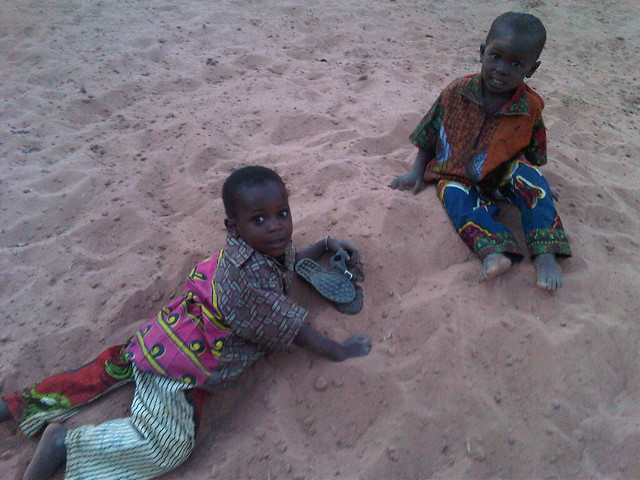
Take for example the simple act of taking out the trash. For reasons that elude me, kids go maniacal over our trash. Giggling hoodlums come barreling towards me in a hysteric blitz, grabbing from every direction. These are well-fed children, so they're not trampling over each other out of desperation so much as they're competing in a game. I imagine it's the same thrill as scrambling for candy from a busted piñata. Except, yeah, it's trash. After the dust clears, they flaunt their prized scraps of plastic and cardboard but often seem puzzled as to what to make of them.


Sometime in early January we baked a Dutch applie pie in our Dutch oven and in the spirit of the Dutch shared our creation with some courtyard kids. An ant colony smelled our picnic and called out the cavalry. And when one kamikaze ant came too close for comfort to my slice, I made an example of it with the bottom of my sandal. Inspired by this murderous act, Fatouma taught us the Jula word for ant by way of song: "Sukaromusa! Ting ting! Sukaromusa! Ting ting!" It was catchy. As everyone sang the mantra, we then jammed out with a percussion ensemble comprised of bottles, pans, and me beatboxing. Since that momentous day, children the village over have somehow learned this little ditty. Round our parts, this special anthem has surpassed that World Cup song by Shakira as the most popular tune around. It's nearly April and we haven't passed a day without the little minstrels singing "Sukaromusa! Ting ting!" Here's the sheet music transcription of the song to immortalize it for future generations and civilizations to discover:

Gone are the days when we could leave the house without hordes of youth flocking around our hips, rubbing our arm hair, holding our hands, singing us songs about ants. I used to egg them on by singing along until I realized hearing it recapitulated for all of eternity may be some kind of Chinese water torture for their parents. If I were a Buddhist monk, maybe I would see the Sukaromusa song as karmic retribution for my momentary lapse of goodwill toward insectkind. Perhaps the universe is trying to remind me of grotesquities of which human nature is capable. It's okay, though. I had to kill it. The ant was after my pie.
Hopefully by the end of November 2012, we'll have earned something greater than our shallow fame as foreigners in the eyes of these youngsters. And hopefully they'll discover a more entertaining pastime than brawling over our moldy banana peals and cheese wrappers. Also hopefully we can sell "Sukaromusa! Ting ting!" to Justin Bieber, it will climb the pop charts, and my village can get rich off royalties.
As a post script, I love how the girl's shirt says: "BIG LOVE IS THE BEST / NO WARS / ONLY FRENCH KISS / ALL YOU NEED IS LOVE." I wonder how many people here ever second-guess what the English means on the apparel they wear daily. For instance, is the bush taxi passenger fellow in the picture below really who his shirt says he is? I should have had him install high-speed internet in my village mudhut while I still had the chance.

As a post post script, Tana told me my Jula spelling of sukaromusa was totally wrong, so I fixed it.
Thursday, March 17, 2011
Roll Up for the Magical Factory Tour!
Written by
Chad
What if Tana finds herself plumb out of confectionery sugar halfway through icing my annual nine-layer birthday cake? Or what if we're having sea pirates over for dinner and realize last-second that stock is short on rum? Fortunately enough, our next door neighbor has the hookups. We're just a hop, skip, and a jump away from Burkina's largest and only sugar factory: Societé Sucriere de la COMOE (SOSUCO).

With over four thousand employees, SOSUCO is to Banfora what Hershey Chocolate is to Hershey, PA. So imagine our giddiness when last week we got golden tickets granting us entry inside the industrial megaplex. This birthplace of all sticky buns and lemon drops; this wonderland of tooth decay and type two diabetes. Today, you too can behold the secret world of imagination that is SOSUCO. Think of Tana as a clownishly dressed Willy Wonka and me as a sun-burnt Oompa Loompa, guiding you through the ten-step process of sugar production. Grab your insulin, cause here we go.


(3) Then it goes to the coolest part ever. While it's being spritzed with water, the paste spins around a centrifuge. You can open it up and watch the sugar crystallize, visibly changing color like a splash of cream in your coffee. At that moment a fleeting sense of appreciation for the miracles of science welled up in my chest, kind of like seeing one of those volcano science fair projects. It may have just been acid reflux.


With over four thousand employees, SOSUCO is to Banfora what Hershey Chocolate is to Hershey, PA. So imagine our giddiness when last week we got golden tickets granting us entry inside the industrial megaplex. This birthplace of all sticky buns and lemon drops; this wonderland of tooth decay and type two diabetes. Today, you too can behold the secret world of imagination that is SOSUCO. Think of Tana as a clownishly dressed Willy Wonka and me as a sun-burnt Oompa Loompa, guiding you through the ten-step process of sugar production. Grab your insulin, cause here we go.

(10) I have reverse-numbered these steps for no reason. The journey from cane to cubes begins out in the fields where the workers unleash a raging inferno upon the unsuspecting crop. This is a technique borrowed from the Brazil, perhaps along with their cultural obsession for soccer. Here workers pile the chopped, char-grilled stalks onto freight trailers towed by John Deere tractors.
(9) Back at the factory, a crane empties all of the medium-rare stalks into the assembly line by lifting the chain beneath them.

(8) Here the cane is rinsed to remove residue from the burning. Maybe the sugarcane is enjoying this warm bath. Maybe it's about to forgive the company for burning it alive and decapitating it with machetes. But don't forgive them just yet, sugarcane. Unspeakable things are about to happen to you...
(7) At this point, the cane is threshed by a gauntlet of rotary blades (pictured below) into a coarsely shredded wood pulp. High upon this catwalk, one misstep could land a careless passerby into the throes of whirling blades or scalding molten sugar. Our tour guide Abdoulaye wore safe industrial attire and a hard hat while Tana and I in our visitor badges scaled the slippery catwalks in Kohls flip flops. Living life on the edge is just how we roll. And I'm thankful mom and dad taught me to walk really well back in kindergarten.


(6) Onward, the pulp continues through the pipeline, passing through six mills, each with one rotating cylinder on top and two below. The pulp is continually rinsed with recirculated juice. The goal here is to juice the living daylights out of the pulp, kind of like trying to squeeze those last few atoms of toothpaste out of an empty tube. The juice drips into a trough proceeding down the rabbit hole.
(5) Now that they've leached all the sweetness from the pulp, the byproduct is saw dust. It leaves the factory on a conveyer belt straight for the stockpile of furnace fuel. SOSUCO goes through 25,000 liters of water per hour pumped from a nearby mountaintop spring. If it helps you visualize the quantity better, that's the equivalent 25,000 one-liter cokes or one 25,000-liter coke per hour.


(4) The juice is decanted and refined through slowly spinning cylinders, filtering out the remaining debris and impurities. What remains is a syrup. The syrup runs through four more towering cylinders that boil it to different temperatures. It comes out as a paste called mesquite. For quality assurance, workers view the sugar crystals through a microscope lens.

In this room, the steam from these machines sugarcoats all the pipes and metalworks in a brown glaze. Dangling from all the machines are brown icicle-like stalactites. The air smells amazing. Inhaling it all the time, I bet the employees are on a perpetual sugar rush.

(3) Then it goes to the coolest part ever. While it's being spritzed with water, the paste spins around a centrifuge. You can open it up and watch the sugar crystallize, visibly changing color like a splash of cream in your coffee. At that moment a fleeting sense of appreciation for the miracles of science welled up in my chest, kind of like seeing one of those volcano science fair projects. It may have just been acid reflux.

(2) Then through a series of tubes (much like the internet), the wet sugar passes through a dehydration room, which looks like it got a light dusting of snow. As you walk through, the song "It's Beginning to Look A Lot Like Christmas" might pop into your head.

(1) The end of the tour is the packaging warehouse where the sugar meets one of two fates: cartons full of cubes or sacks of the granular variety.


We were allowed to eat as many sugar cubes as we could while inside the compound, so our impoverished eleven-year-old buddy Abu who tagged along shoveled as many as possible into his gullet. I dramatically handed a sugar cube back to my tour guide (like Charlie does with the everlasting gobstopper), but unfortunately Abdoulaye refused to show us the Wonkavator.
Monday, February 28, 2011
Salesman of the Year Award
Written by
Chad
Traveling alone, I hop on a packed charter bus from Bobo-Dioulasso to Banfora. There are 50 seats plus people sitting in the aisles. This guy opens a bag of chocolates and gives one to everybody on the bus. I take this gesture as a random act of kindness and forget about it until twenty minutes later he gets up again. He starts handing out tiny booklets for everyone to read. I'm assuming at this point he's some sort of a missionary. He starts talking, but I'm not in the mood to convert today, so I just gaze out the window and try to calculate the last digit of Pi.
Later, a few booklets eventually make it back to me, and I read the title- something about the marvels of urotherapy. Not sure what that is, so I open to the table of contents and skim through. So this is a booklet about the healing properties of urine? Looking at everyone's faces, they're all taking it seriously. It explains that since urine is actually blood filtered through the kidneys, it's the purest kind of liquid. It can be ingested or applied to the skin to clean out toxins. By passing through the digestive tract, urine gains valuable nutrients, such as vitamins and neurotransmitters. It says if you coat your skin in urine, you will sweat less. The taste is like vegetable broth with the fresh scent of hay. At this point I've been staring at this booklet for a long time, like a kindergartener taking more than five Mississippis at the water fountain. So I pass it back to other passengers.
The next stage of the pitch: The man unveils a bingo dotter filled with a green liquid. He had apparently dyed the urine green and added a minty fragrance to it. Bingo dotter in hand, the man walks row to row, asking each person if he can rub the scented green urine on the back of their necks. People are giggling and looking at each other, but I watch as most everybody complies. After making his rounds, he sells boxfuls of this scented green urine in clear plastic baggies to about half the bus. It's all about presentation, I suppose.
It reminds me of the guy in Tommy Boy who could sell a ketchup popsicle to a woman in white gloves. But I think selling people your own urine is even more impressive.
Later, a few booklets eventually make it back to me, and I read the title- something about the marvels of urotherapy. Not sure what that is, so I open to the table of contents and skim through. So this is a booklet about the healing properties of urine? Looking at everyone's faces, they're all taking it seriously. It explains that since urine is actually blood filtered through the kidneys, it's the purest kind of liquid. It can be ingested or applied to the skin to clean out toxins. By passing through the digestive tract, urine gains valuable nutrients, such as vitamins and neurotransmitters. It says if you coat your skin in urine, you will sweat less. The taste is like vegetable broth with the fresh scent of hay. At this point I've been staring at this booklet for a long time, like a kindergartener taking more than five Mississippis at the water fountain. So I pass it back to other passengers.
The next stage of the pitch: The man unveils a bingo dotter filled with a green liquid. He had apparently dyed the urine green and added a minty fragrance to it. Bingo dotter in hand, the man walks row to row, asking each person if he can rub the scented green urine on the back of their necks. People are giggling and looking at each other, but I watch as most everybody complies. After making his rounds, he sells boxfuls of this scented green urine in clear plastic baggies to about half the bus. It's all about presentation, I suppose.
It reminds me of the guy in Tommy Boy who could sell a ketchup popsicle to a woman in white gloves. But I think selling people your own urine is even more impressive.
Wednesday, February 23, 2011
Dealing Drugs
Written by
Chad
The first time I heard about it on a radio program in the States. The segment was about some American dude who woke up in a train station in India with no memory of his own identity. He had no idea who he was or how he got there. The national authorities eventually found his name was David and got him the next flight home to his family. It was as if he was meeting his parents, his girlfriend, and (through photo albums and stories) his former self for the first time. It turns out that the same culprit responsible for his freak memory loss is the malaria drug that I take every Sunday. Small world.
The next time I heard about it, we were fresh off the plane and a second-year volunteer was lecturing us about the drug-induced schizophrenia we would inevitably experience: "This one girl woke up in the middle of the night, hallucinating that the ceiling was melting!" Hallucinations? I wondered whether this drug would wake me nightly in the wee hours to confront each of my greatest fears, one by one brought to life at the foot of my bed: ghosts of dead British children, horseshoe crabs, ventriloquists, crowded locker rooms. You know, the kind of stuff that horrifies all of humanity. I was prepared to voluntarily commit myself to the regional psych ward.
Thankfully, such hallucinatory night terrors have only haunted me once. In some sort of paranoid stupor, I awoke three times throughout the night believing spiders in my mattress were sucking blood from my back. I remember repeatedly bolting upright and brushing the creepy crawlies off my sheets, groaning at Tana to fetch the bugspray. I sat up each time (my go-to knee jerk reaction), half-believing it was true and half-believing the vision was false. After about fifteen seconds of vividly staring at these tricks of the imagination, all smoke would clear and I would realize I had been yet again deceived by the small white malaria pill called Mefloquine
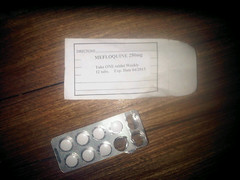
Mefloquine isn't always psychoactive in a spooky way- while on this drug, I've had some of the most vibrant, dazzling dreams of my life. One night while snoozing, I found myself swinging from treetop to treetop in a rainforest by grabbing hold of the tails of multicolored snakes, the kind that don't bite and like to be swung from. Before Mefloquine, I've only ever achieved this quality and intensity of dreams after binge overeating at a Chinese buffet.
Way before the flesh-eating spider attack, I experienced three memorable hallucinations on separate nights. In the first, I sat up in bed, realizing I was somehow seated in a bustling airport terminal while people were hurrying past me on either side. The surrounding movements and commotion gradually dissolved to reveal the only movement around me was the wind rustling the mosquito net. Telle me, why again do I need that thing when I'm already sacrificing my sanity to be malaria-free?
During my second lapse of reality, Mefloquine convinced my brain that Tana and I had accidentally dozed off beside a swamp under a willow tree. Twice that night, I woke up and prodded Tana's arm, saying "We need to go home. It's gonna get dark soon." I was about to make a beeline for who-knows-where, until Tana talked me down like a hostage negotiator, and the swamp disappeared in a puff of smoke. Or maybe a puff of swamp gas.
The third incident was last night. I awoke, my eyes fixed on the ceiling, realizing that the neighbor kids in my courtyard had somehow fashioned a trap door in the roof above our bed. I saw their heads peering down at me. They had tied a rope around a box the size of a care package. They were lowering the box slowly towards the bed, Mission Impossible style. I swatted the box away with my hands. But when consciousness returned, the box turned out to be, you guessed it, that accursed mosquito net again. That net is the Roadrunner to my Wile E. Coyote.
Tana herself suffered some health problems resulting from Mefloquine early on, so after two months she switched to the daily pill Doxycycline. Before ending her stint as a Mef-head, she had one hallucination that was pretty trippy while we were still living with our host family. She saw a person looming over us, holding a tree branch with berries over our bodies. They were performing some sort of traditional healing on us. She remembers feeling perturbed that one of our host family members had broken in and was trying to heal us. Then she realized nobody was there.
By the way, you're probably really confused, because you thought this was an entry about illegal drug dealing. Sorry, the entry title is a typo- it's supposed to say "Dealing with Drugs." Having told you this, I expect you to read it all once more, bearing in mind that the subject is about coping with our government-issued malaria medicine. If you started reading this because you're an aspiring drug dealer, all I have to say is this: clean up your act, young man.
The next time I heard about it, we were fresh off the plane and a second-year volunteer was lecturing us about the drug-induced schizophrenia we would inevitably experience: "This one girl woke up in the middle of the night, hallucinating that the ceiling was melting!" Hallucinations? I wondered whether this drug would wake me nightly in the wee hours to confront each of my greatest fears, one by one brought to life at the foot of my bed: ghosts of dead British children, horseshoe crabs, ventriloquists, crowded locker rooms. You know, the kind of stuff that horrifies all of humanity. I was prepared to voluntarily commit myself to the regional psych ward.
Thankfully, such hallucinatory night terrors have only haunted me once. In some sort of paranoid stupor, I awoke three times throughout the night believing spiders in my mattress were sucking blood from my back. I remember repeatedly bolting upright and brushing the creepy crawlies off my sheets, groaning at Tana to fetch the bugspray. I sat up each time (my go-to knee jerk reaction), half-believing it was true and half-believing the vision was false. After about fifteen seconds of vividly staring at these tricks of the imagination, all smoke would clear and I would realize I had been yet again deceived by the small white malaria pill called Mefloquine
Mefloquine isn't always psychoactive in a spooky way- while on this drug, I've had some of the most vibrant, dazzling dreams of my life. One night while snoozing, I found myself swinging from treetop to treetop in a rainforest by grabbing hold of the tails of multicolored snakes, the kind that don't bite and like to be swung from. Before Mefloquine, I've only ever achieved this quality and intensity of dreams after binge overeating at a Chinese buffet.
Way before the flesh-eating spider attack, I experienced three memorable hallucinations on separate nights. In the first, I sat up in bed, realizing I was somehow seated in a bustling airport terminal while people were hurrying past me on either side. The surrounding movements and commotion gradually dissolved to reveal the only movement around me was the wind rustling the mosquito net. Telle me, why again do I need that thing when I'm already sacrificing my sanity to be malaria-free?
During my second lapse of reality, Mefloquine convinced my brain that Tana and I had accidentally dozed off beside a swamp under a willow tree. Twice that night, I woke up and prodded Tana's arm, saying "We need to go home. It's gonna get dark soon." I was about to make a beeline for who-knows-where, until Tana talked me down like a hostage negotiator, and the swamp disappeared in a puff of smoke. Or maybe a puff of swamp gas.
The third incident was last night. I awoke, my eyes fixed on the ceiling, realizing that the neighbor kids in my courtyard had somehow fashioned a trap door in the roof above our bed. I saw their heads peering down at me. They had tied a rope around a box the size of a care package. They were lowering the box slowly towards the bed, Mission Impossible style. I swatted the box away with my hands. But when consciousness returned, the box turned out to be, you guessed it, that accursed mosquito net again. That net is the Roadrunner to my Wile E. Coyote.
Tana herself suffered some health problems resulting from Mefloquine early on, so after two months she switched to the daily pill Doxycycline. Before ending her stint as a Mef-head, she had one hallucination that was pretty trippy while we were still living with our host family. She saw a person looming over us, holding a tree branch with berries over our bodies. They were performing some sort of traditional healing on us. She remembers feeling perturbed that one of our host family members had broken in and was trying to heal us. Then she realized nobody was there.
By the way, you're probably really confused, because you thought this was an entry about illegal drug dealing. Sorry, the entry title is a typo- it's supposed to say "Dealing with Drugs." Having told you this, I expect you to read it all once more, bearing in mind that the subject is about coping with our government-issued malaria medicine. If you started reading this because you're an aspiring drug dealer, all I have to say is this: clean up your act, young man.
Subscribe to:
Posts (Atom)